
I want to begin by saying something that is rather controversial these days; I am pro-building out the infrastructure for the future of the world. That doesn't mean it should come without regulation or checks and balances between giant corporations and the places where they build, but our goal should be to lead this expansion. This would be the first physical infrastructure buildout this country has genuinely led on since the Highway Act in 1956, which by my math is 70 years ago. It is true that we led on internet and on cloud (not the shoes), but those were mostly buildouts of software, fiber, and straight up capital deployment more than that of concrete and copper.
On the physical side the record since the interstates is thin: no true high-speed rail line has ever been built (I love Amtrak but look up the bullet trains they have in Asia and you'll think we are living in the Stone Age), and then there is of course the most obvious one-to-one to data centers that we fell short on: nuclear. Negative PR campaigns mixed with a few genuine accidents and all the negatives that come with the word nuclear put the energy build on the permanent back burner up until rather recently.
Data centers cross between both the physical economy as well as the non-physical because of what they do, but this is the first chance in seventy years to lead on one of these again. As I said above however, I do believe there should be some checks and balances on the companies building them. But as long as they follow the rules, I say: let them build.
In places all over the country, there are families achieving generational wealth because of this too: ninety-six families in one Pennsylvania township sold about 1,700 acres to Blackstone's QTS for more than $500 million, which works out to roughly $300,000 an acre, in a state where USDA puts average farm real estate at $9,560 an acre; a farmer outside Harrisburg was offered $15.7 million for 261 acres and took under $2 million from a land trust instead, because he did not want his farms destroyed; a mother and daughter in Mason County, Kentucky turned down $26 million, about ten times local land value, while the county rezoned 2,080 acres around them; and central Ohio farmland that went for $30,000 an acre clears $150,000 once it is rezoned for a campus, per the trade press that tracks the deals. This is tantamount to hitting the grand prize on a scratch off ticket you got from a gas station.
That being said when a private company, typically one of the five-to-ten biggest in the world operating using a shell LLC with tons of NDAs being signed in backrooms, looking to buy several hundred acres, a nine-figure grid connection, and a water contract from your county, you are allowed and you should ask questions about it. Those two positions are not in tension. But that isn't what happened though over the past year. It is far more, for lack of a better term, stupid.
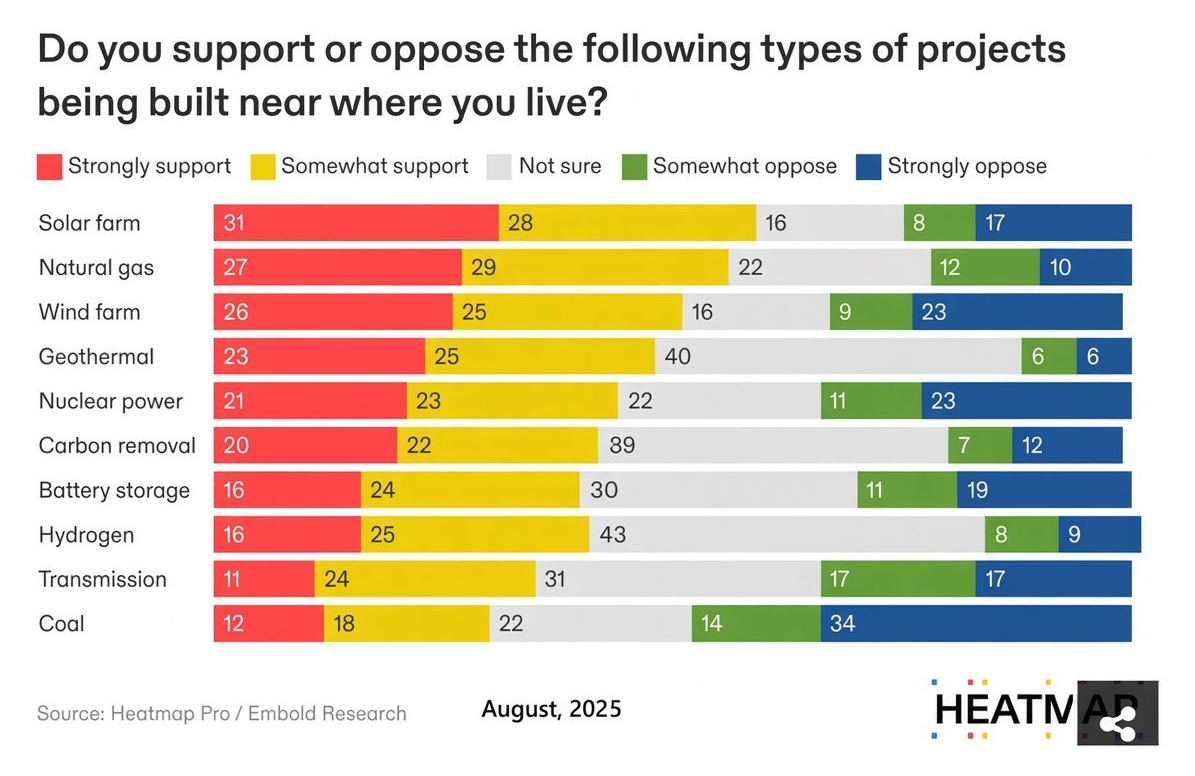
In August 2025, asked whether they would support a new data center near their home, registered voters were split down the middle: 43 to 42. In February of this year the pollster saw a gap widen 28% support with 52% opposing. And just earlier this month, on a poll conducted by the same pollster, support was at 15% and opposition at 75%, with 61% strongly opposed.
Strong opposition went from 24% to 61% over those twelve months. For scale: in that same August 2025 wave, the least popular energy project tested was a coal plant, at 30% and a net of -18, and data centers out-polled coal by 13 points. Today data center support, at 15%, is half of what coal polled at in 2025. Two times as many people prefer a coal plant to a data center; what is happening?!?
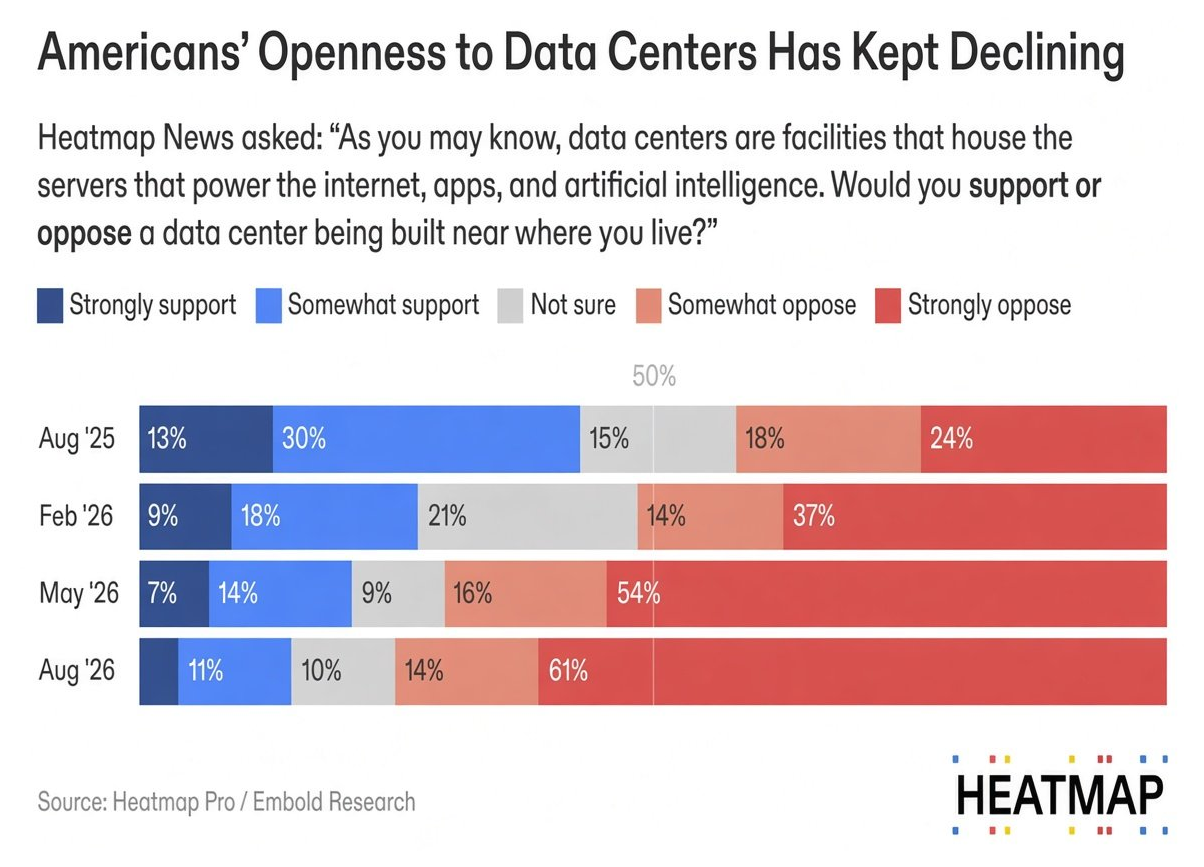
I don't think I've ever seen public support move this much on a single issue. Part of that is rising electricity prices and looking for someone to blame. It is easy to blame the new building that goes on forever that uses a ton of electricity but there is more to it than that. There is a semi-documented mostly undocumented foreign-funding story in this fight that is much more heinous and that has wrapped its tentacles around every aspect of disinformation and is winning.
I won't defend every project, every operator, or every siting decision. Some projects probably shouldn't get the green light. But what I will say is this: the backlash has decoupled from the measurable harms, and the gap between the two is now the single largest risk in the data center buildout, and both the builders as well as the opponents are not doing a good job explaining why these either need to be built or why there should be a moratorium. For the opponents, this is likely because the measurable harms are smaller than the campaign is saying they are, but that doesn't stop them from saying what they will do, and they are winning. And for the industry trying to build these out, that is due to horrible PR campaign much in part thanks to leaders of these AI companies saying that these will destroy the white collar labor sector and take with it all of your jobs.
So let's talk about what these are, what they do, and what we should do.
What Are Data Centers and Why Are We Building So Many of Them
A data center historically has been a building full of computers, power equipment, and cooling. That description covered the industry for thirty years, from the dot-com era through the cloud era, while the facilities sat in office parks and nobody really thought too often about them. The AI buildout changed the physical object.
Now, to grasp what they are you have to think of them as the physical backbone of the modern economy: supporting cloud computing, banking, healthcare, manufacturing, universities, national security, small businesses, streaming services, and the AI tools being adopted across nearly every sector. Like rail lines, power plants, warehouses, and steel mills before them, data centers are large infrastructure projects that require careful local planning. Their scale should not be confused with inherent harm, but also should not be blindly trusted.
The unit that matters is the megawatt. A large cloud data center of the pre-AI era drew power in the tens of megawatts. The AI campuses now in planning will draw hundreds, while the largest announced projects cross into gigawatts, which to put into reference is the scale of a large (aforementioned) nuclear plant.
The growth is real and the record is public. The Lawrence Berkeley National Laboratory put US data center consumption at 58 terawatt-hours in 2014 and 176 in 2023, which was 4.4% of all US electricity. Its 2024 report projected a 2028 share between 6.7 and 12.0%. The 2025 update, using newer chip-shipment data, runs the predictive 649 terawatt-hours by 2030, which would be 11.8% of US electricity, within a range of 9.5 to 15.3%; I'll go out on a limb and predict it lands on the upper end of that range.
And the buildout is not staying where data centers already live. A McKinsey and Co. report estimates that hyperscalers and co-location providers have announced more than 2,600 new facilities, with roughly one quarter of them slated for cities that have no existing data center footprint (which is the driving force of what is genuinely scaring people) on the way to a global stockpile approaching 11,000 of them by the early 2030s.
Why the schedule compresses to the point of collision: the chips. An AI accelerator is the most expensive thing the operator owns and it loses value on a clock, both because the next generation obsoletes it and because every idle week is a week a competitor trains. So the hyperscalers, the handful of companies building at this scale, commit to buy the chips first and then need buildings and power on the chips' schedule rather than the grid's. Interconnection queues run years now. The industry's response has been to route around the queue: gas turbines behind the meter, contracted nuclear output, and land purchases in whichever county says yes fastest.
The chips are already outrunning the buildings. A new report from BloombergNEF puts US data center capacity at 118 gigawatts by 2030 on its base case and 194 by 2035, and then runs a second forecast built from expected AI chip deliveries, which implies 207 gigawatts in the US by 2033, a gap of 63 gigawatts between what the chips say should be built and what BNEF thinks will be, due to energy constraints (meaning companies are being overly optimistic—surprise, surprise). At 2030 that gap is about 42 gigawatts, which is to say 42 gigawatts worth of chips could be stuck in inventory by 2030.
Too many AI chips, too little power
This outcome seems almost impossible for the tech industry to avoid. Chips—which aren't easy to build either for what it's worth—are made in factories, while they need to be powered in physical infrastructure that is even more difficult to permit and build. So this isn't just a local opposition problem for data center developers. There are plenty of other constraints that could throttle data center capacity: skilled labor, specialized power and cooling equipment, the optical interconnect and transceiver supply chain that ties the racks together, and the transformers and switchgear that every substation needs and every other industry is also trying to buy.
But the binding constraint is none of those. It is the speed at which a specific county will let you connect a specific building to a specific substation, and that speed is set by local politics. Which is why the polling collapse in the above section is not a public-relations problem, but a schedule input.
What do Data Centers do; The Numbers
Every fight over a data center is basically a fight around what they will do to the environment, the economy, or both. I will attempt here to address most of those arguments:
POWER
This was already stated above: data centers used 4.4% of US electricity in 2023, and are on a path to roughly 12% by 2030 based on the 2025 predictive guide. The national number is almost beside the point though, because the load is not distributed nationally. It concentrates where fiber, land, and tax treatment already are, which means a handful of utility zones absorb growth the national average smooths away. Where that concentration is most extreme is the PJM footprint, and Northern Virginia within it, which is why the price story starts there and then stops making sense there. When people say they aren't building data centers in rich areas, I suggest people look at these Virginia zip codes where these data centers are located, it might surprise them.
BILLS
PJM is the grid operator for all or part of thirteen states and Washington, DC, and it runs the wholesale power market for more than 67 million people. Its own independent market monitor ran the counterfactual: what would capacity have cost without data center demand. The answer was that current and projected data center load raised capacity costs 174% for the 2025-26 year, which is about $9.3 billion. That is not a share-of-charges statistic that can be argued about. It's a modeled difference against a world where the load does not exist, produced by the entity PJM pays to police its own market. The auction prices that came out of it went from $28.92 per megawatt a day to $269.92 to the federally approved cap at $329.17, and the zone peaks landed exactly where the campuses are, $466.35 around Baltimore and $444.26 in Dominion's Virginia territory.
Now leave PJM, because almost every argument in this fight is a PJM argument being applied to a country that mostly is not in PJM.
Residential electricity prices rose 42% nationally over five years. That is a national number and it has national causes, most of which have nothing to do with data centers. Utility spending on distribution alone rose 160% between 2003 and 2023, to $50.9 billion a year. Rate requests hit $18 billion in 2025, the highest level this century, and sector capital spending is projected to rise another 17% in 2026 to $238.8 billion. Natural gas, which sets the marginal price of power in most of the country, is running about $4.01 per MMBtu this year against $3.56 last. Add in storm and wildfire, an aging fleet, and a decade of deferred maintenance arriving on the same bill and you get some less than great numbers.
Data centers are one input into that. They are not the input, and numbers prove it. Washington DC is up 94% over five years, Maryland 74%, New York 58%. Maine is up 73%, and Maine spent this spring debating a moratorium on data centers it does not have, because the first one has not even been built yet. A state with essentially zero data center load has watched household bills rise three quarters in five years. If the buildout stopped tomorrow, the wires, the gas, and the storm hardening would still be there, and so would most of the increase.
The most-repeated figure in this fight, that bills near data centers rose "as much as 267%" is a wholesale price at particular grid nodes between April 2020 and April 2025, and wholesale is only 30 to 50% of what a household actually pays. PolitiFact rated it Mostly False. The claim survives anyway, because the number is good, correction is boring, and perception is reality.
To solve some of the utility bill issues some states have started to implement common sense solutions that will no doubt start being the norm, Ohio's utility commission approved a tariff in July 2025 requiring new data centers above 25 megawatts to pay for at least 85% of contracted capacity every month whether they use it or not, on a twelve-year structure, with an exit fee of three years of minimum charges. Georgia's commission went further in January 2025: loads of 100 megawatts or more sign custom contracts, pay the upstream generation and transmission costs they cause, and Georgia Power has to demonstrate quarterly that data center revenue is reducing residential bills rather than raising them, with base rates frozen through 2028. Texas wrote the same kind of instrument and then abandoned the approach. SB 6, signed in June 2025, lets the grid operator curtail large loads during emergencies, requires the curtailment equipment be installed before interconnection, and rewrites cost allocation and colocation rules. On August 3, 2026, Governor Abbott directed the state utility commission and ERCOT to audit every data center moving through the interconnection process, said the audit must finish before any project moves forward, and said any project that fails its requirements will be denied connection to the grid. There are 474 gigawatts of requests in that queue, about 90% of them data centers, and they are all now waiting. Texas had the tariff answer in hand fourteen months earlier and pressed pause anyway.
And the design space goes further than cost allocation, which is where I would push it. If a campus lands in your county, it should not merely stop raising your bill; it should lower it. New York has a bill that would require any new data center, or any existing one expanding by 20 megawatts or more, to fund a host community benefit program paying direct utility bill credits to residential customers, or funding heat pumps, or rooftop solar, and storage for them. Pennsylvania's PPL negotiated the first separate data center rate class in the state, carrying $11 million into the residential low-income program. The White House has a voluntary pledge along the same lines, under which companies negotiate separate rate structures and pay for the infrastructure brought online to serve them.
That is the deal that should be standard, and it is the one the industry should be racing to offer rather than waiting to be handed. A data center is the rare neighbor that can actually cut your electric bill, because it buys power in enough volume to carry fixed costs that would otherwise be spread across households. Structure it that way and the fight changes character. Leave it unstructured and every rate case becomes a referendum. The tools already exist, are already approved, and are already operating. That is worth holding next to a national construction ban with no expiration date.
WATER
The most repeated numbers I see in local fights are water use numbers. US data centers directly consumed about 17.4 billion gallons in 2023; an absolute eye-popping number with projections of 38 billion on the low end all the way up to 73 billion per year by 2028, with figures assembled by a state legislative science office from EPA and Berkeley Lab work. That seems bad, and when reading that without a frame of reference you might be taken aback and getting ready to protest but hold off for just one moment.
Today, the United States withdraws 322 billion gallons per day, 118 billion of it for irrigation. This is actually a key distinction: that 322 billion is withdrawal, water taken out of a river, lake or aquifer, and the 17.4 billion is consumption, water that does not go back, and the difference matters, because most water withdrawn for cooling and thermoelectric use returns to the source, while most irrigation water does not. But even comparing the industry's annual consumption against a single day of national withdrawals tells you the national water story is not a real story whatsoever.
The location here matters. A new campus drawing from a stressed aquifer in a drought county is a real conflict that no national denominator dissolves. The same campus on reclaimed municipal water is not a story at all. A water number without a basin, a period, and a share is not analysis.
NOISE
The Commonwealth of Virginia has measured this. They found noise at operating facilities, including facilities that had generated resident complaints, was generally comparable to ordinary background sound, in a range of roughly 40 to 59 decibels, which sits between a library and a conversation with someone three feet away. Complaints are not confined to Virginia; the record includes Texas and Arkansas, and residents near facilities have reported headaches, sleep disruption, and worse. The measurement problem is real and cuts a specific way: much of the energy is low-frequency, under 100 hertz, which travels farther than the A-weighted meter used in most ordinances captures, so a facility can be simultaneously compliant on paper and intolerable at the property line. That is an argument for writing a better standard, not for a ban. Noise is the one complaint in this entire fight that is fully solvable with a number in a permit condition.
TAXES
Again borrowing from Virginia's auditor and the wonderful data that they have provided the public. They have put the industry's statewide contribution at 74,000 jobs and $9.1 billion in annual GDP, most of it from construction. Loudoun County states on its own website that data centers generate almost half of its property tax revenue. New Albany, Ohio has taken 40 of them since 2010 and structured the deal so each pays a minimum annual amount equivalent to what the site would produce as corporate offices or advanced manufacturing, which is how one facility ends up generating $3.9 million in local tax revenue, the equivalent of an employer with a payroll above $165 million.
That last clause is the whole tax argument. Data centers are the rare development that produces industrial-scale assessed value with almost no demand on schools, roads, or emergency services, because almost nobody works there. The failure mode is not the facility, it's the abatement: a county that gives away the assessed value to win the project keeps the land use and loses the revenue, and school districts are where that will show up first.
Current rates allocate costs appropriately, but growing demand is likely to increase other customers' costs. Hold the two geographies next to each other. The tax lands in one county's budget. The capacity charges are socialized across a thirteen-state grid. One county gets the high school, thirteen states get the bill, and that arithmetic, more than any environmental claim, should be the political engine of this fight, but it is not sexy or easy to convey to voters. So claims around water usage with no frame of reference will have to do.
Who Benefits From a Slow Down
China.
China runs a coordinated national siting program. The policy, East Data West Computing, was introduced in the 2021 Three-Year Action Plan for new data centers and launched as a multi-agency national project in February 2022. In it they designated eight hub node regions, five of them in the west, to push training and storage workloads toward cheap land, cold air, and surplus generation. The state's industrial ministry maintains a green data center program; its late 2025 list approved 60 facilities for subsidies, tax breaks, and reward funds, with local supplements running up to one million RMB, which is on the order of $140,000, per facility. The coordination is real, and the subsidies are small.
The Oxford Institute for Energy Studies found in a February 2026 report that Chinese industrial electricity prices are comparable to American ones (who both have lower costs than Europe) and that East Data West Computing has had limited effect because most load cannot actually move west, and that the lower western prices are offset by duplicated upfront costs carried largely by state-owned companies. So the honest version of the asymmetry is not that China subsidizes power and we do not.
The honest version is better. The same research found China faces no national electricity supply barrier to data center growth; its grid is overbuilt, and data center demand there mostly displaces other industrial load rather than straining the system. China's binding constraint is their lack of chips. America's binding constraint is the interconnection queue and government intervention. One of those constraints is imposed by an adversary's export controls. The other one is self-imposed, and it is the only one a competitor benefits from watching us tighten.
The foreign funding record, at the strength the documents support. An April 2026 advocacy report revealed more than $39 million in foreign donations to twelve American organizations that oppose data center expansion, naming European foundations and donors. A second report the following month built the allegation of a coordinated campaign on top of that funding record, and the allegations have produced congressional inquiries. The May report concedes, in its own text, that whether the funding streams amount to coordination is a question for foreign-agent enforcement, and as of this writing no entity has been charged, none has lost tax-exempt status, and all continue to operate. The funding is documented; the coordination is an open allegation with zero enforcement actions behind it, and no matter how someone may feel, likely none to come from it.
If this is somehow coordinated by China, then man what a bargain they are getting. Slowing down the AI buildout in America while simultaneously building out their own capacity that they currently lack....while also sowing disconnect between politicians, companies, and people; all for what seems like an inexpensive price tag? The CCP probably has to pinch themselves.
What Should Actually Happen
We briefly discussed Ohio above, but there are also similar legislative processes ongoing in New York and Pennsylvania that are drafting legislation where the data center campus lowers residential bills instead of raising them. Neither of those required national construction bans, or requires them to wait for one. A state or county that wants a data center to pay its own way has a template. It is unfortunate then, that a politician whom I revere so much like Governor Josh Shapiro is instead moving the other direction. His data center executive order earlier this week (I am writing this on publication date August 24th) stops short of a ban, but it kills the fast-track permit path and imposes the GRID standards his own Senate would not pass. I will also add that included in the EO is a barring of state agencies from signing non-disclosure agreements on these projects, which is the one part I would keep.
I think the real question needs to be pointed at the companies who have ran about as bad of a PR campaign as you can imagine. Dario Amodei, Sam Altman, Elon Musk, and Mark Zuckerberg are talking to almost any podcast that will have them (I'll need to have a roundtable on Backseat Quarterbacks this year) and they are making some rather wild claims. The elimination of half of all jobs, the chance that the worst possibilities can become reality, etc. For Altman and Amodei it might make some sense, they have never been exposed to big tech fame, but for Zuckerberg and Musk it really is confusing. These are media trained leaders who have been public facing for decades now. They both have their critics (me included) but did they not get any rehearsed answers for these kinds of questions? They aren't even "gotcha" questions, these are friendly interviews!
Here are some of the lines; I am pulling them from the findings section of the federal bill that would halt data center construction indefinitely:
Elon Musk, CEO of Tesla and SpaceX: "AI and robots will replace all jobs. Working will be optional." And separately, that artificial intelligence is akin to "summoning the demon."
Dario Amodei, CEO of Anthropic: "AI could displace half of all entry-level white collar jobs in the next 1 to 5 years," and "humanity is about to be handed almost unimaginable power, and it is deeply unclear whether our social, political, and technological systems possess the maturity to wield it."
Mustafa Suleyman, CEO of Microsoft AI: most white-collar work "will be fully automated by an AI within the next 12 to 18 months."
Jim Farley, CEO of Ford: artificial intelligence will eliminate "literally half of all white-collar jobs in the U.S."
Geoffrey Hinton, The "Godfather of AI": there is a "10 to 20 percent chance [for artificial intelligence] to wipe us out."
Larry Ellison, Co-founder and Chairman of Oracle: an AI-powered surveillance state where "citizens will be on their best behavior, because we're constantly recording and reporting everything that is going on."
Bill Gates, Co-founder of Microsoft: humans "won't be needed for most things."
Demis Hassabis, Co-founder of Google DeepMind: the AI revolution will be ten times bigger than the industrial revolution and ten times faster.
Most of these are meant to be promotional! Executives said them to sound visionary in front of investors or a podcaster, and when you tell a country for two years that your product will eliminate its jobs, you can't be too surprised when the country declines to host the building it runs in.
There is no national campaign explaining what a data center is. There is no operator publishing its own water draw against the basin it sits in. There is no trade group running the numbers for example in Quincy, WA against the numbers in the counties currently being asked to vote. The opposition has organized petitions, some crazy but passionate people, and cross aisle support, and have unseated commissioners in both parties, and a national poll has moved thirty points. The response has been press releases about job creation that nobody believes because the perception is that it's fake.
Quincy by the way, is a farming town of about 8,500 in central Washington sitting on two public hydro plants on the Columbia River, and it has hosted data centers since Microsoft bought 75 acres of bean fields there in 2006. It now has roughly 30 of them, and they supply 57% of the city's property tax revenue. The poverty rate was 29.4% in 2012 and is now 6.2% in 2024. The town opened a $15 million aquatic center this summer and has built a $120 million high school, a hospital, a library, police and fire stations, sidewalks, a sewer system, and a wastewater treatment plant on the revenue. Roughly 900 jobs, at a state-estimated four to six additional jobs each. In twenty years the city has transformed.
However, there is also an escape hatch literally being priced in. A startup put a sixty-kilogram satellite carrying a single data-center-class Nvidia GPU into orbit in November 2025 and trained a small AI model on it a month later. Google has a program to fly prototype solar-powered TPU satellites by early 2027. Jeff Bezos has predicted gigawatt-scale orbital data centers within ten to twenty years. SpaceX went public in June at a $2.3 trillion valuation on the largest IPO in American history, and while Starlink is what pays the bills today at 61% of revenue, orbital compute is a real part of the forward story investors are buying.
The distance matters though: that is one GPU in orbit, not terrestrial campuses drawing hundreds of megawatts, with heat rejection and launch mass unsolved. Nothing about it changes a siting decision being made in 2026, and it will not absorb 42 gigawatts of stranded chips by 2030. What it tells you is how the most sophisticated builders on earth privately rate their odds of getting a large computer approved next to American voters. They are seriously evaluating whether low earth orbit has a better feasibility chance than Spokane County.
We are about to lose the first physical infrastructure buildout this country has had a chance to lead in seventy years, and we are going to lose it to China. The chips are going to get made regardless, and that is the whole point: they come off a fabrication schedule nobody in a county hearing room controls, and they get plugged in wherever there is a buyer, power, and a permit waiting. Forty-two gigawatts of them are already projected to have nowhere to go here by 2030. My opinion is that China is at least partly funding the campaign against building them here while it works on getting the chips it does not have, and that nobody will ever be held accountable for it. We are not going to lose it to a genuine environmental finding. The harms that can be measured are smaller than the campaign against them needs them to be, and the one that has been measured most carefully, noise, came back as background sound (pun intended). We are going to lose it to a bureaucratic hearing calendar, a capacity charge nobody bothered to structure correctly, and an industry that spent two years telling the public its product would take their jobs and then went quiet when the public started believing it.