
A Billion Dollars A Day
The war we were promised would never happen is costing America nearly a billion dollars every 24 hours, has killed six American soldiers and over 1,300 Iranians including 181 children, has effectively shut down the Strait of Hormuz, and has no end date in sight.
The U.S.-Israeli war on Iran, launched February 28, 2026, has cost an estimated $3.7 billion in its first 100 hours, is burning nearly a billion dollars per day, and has produced no defined exit strategy. Six American soldiers are dead. Over 1,300 Iranians have been killed, including 181 children, 165 of them girls at an elementary school in Minab. Gas prices have spiked 32 cents in a week. Oil is approaching $90 a barrel. The Strait of Hormuz is effectively closed for the first time in modern history. This paper examines what the war is costing in real time, places it in the context of 25 years of post-9/11 military spending that has consumed an estimated $8 trillion, and argues that the pattern of unfunded wars and unfunded tax cuts has fundamentally shaped the fiscal reality Americans live in today. The war was unnecessary. The costs are staggering. And history says they will be far higher than anyone is currently admitting.
A Quarter Century of This
I often explain to people that I see my life through a sports calendar. My seasonal depression runs from when the football season ends until the weekend of the Masters. And the moment I gained consciousness as a human being—the moment I became aware I was a person living in a world—was during the Patriots’ first run to a Lombardi trophy in the 2001-2002 season. That was February 2002.
But five months before that trophy, before I had any framework for understanding what I was watching, I remember the television coverage of the World Trade Center being hit and coming down. I was five years old. I didn’t understand what it meant. I know now that it fundamentally changed the direction of this country, but I obviously didn’t know it then.
We went to war in Afghanistan on October 7, 2001. The official end of that combat mission was August 30, 2021—the longest war in American history, surpassing Vietnam by roughly six months. I was five when it started and twenty-four when it ended. Nearly my entire conscious life.
Two years into that war, the Bush administration petitioned Congress and received authorization to invade Iraq and remove Saddam Hussein, on the intelligence that he possessed weapons of mass destruction. That intelligence turned out to be false.
The Iraq War started out popular—nearly 70 percent of Americans approved at the beginning—just as the Afghanistan war had. By the time combat operations officially ended in 2011, it was deeply unpopular. We were out for three years before ISIS overran much of the country and we went back in. That campaign only ended in 2021.
~3,000 killed on September 11, 2001. Over 7,000 U.S. military deaths in Iraq and Afghanistan. More than 53,000 U.S. service members wounded. An estimated 900,000 total killed across all post-9/11 conflicts (Watson Institute, Brown University). 38 million people displaced. $8 trillion in total cost.
I am not breaking new ground talking about the costs of these wars. Smarter people than me have been doing that for two decades. But I do think the scope of what America has spent—in money, in lives, in time, in opportunity—is simply beyond what most people hold in their heads at any one time. We know the wars were expensive. We don’t feel how expensive.
Sometimes time is a flat circle in the worst possible ways. In 2001, we elected a president whose administration had us fighting wars across the Middle East for years, on intelligence that turned out to be wrong, at a cost that turned out to be astronomical, and accomplished very little that lasted. It is now 2026. We elected another president whose administration has us fighting a war in the Middle East, on the claim that a country whose nuclear program we “obliterated” eight months ago somehow needs to be obliterated again, at a cost approaching a billion dollars a day, with no defined end in sight.
What Is Happening Right Now
At 9:45 AM local time in Iran on February 28, 2026, the United States launched Operation Epic Fury. Israel launched its parallel campaign, Operation Roaring Lion, simultaneously—two names that our extremely qualified secretary of slam poetry likely took weeks thinking up. Over 1,700 targets were struck in the opening salvo using B-1 bombers, B-2 stealth bombers, B-52 Stratofortresses, LUCAS drones, and sea-launched missiles. President Trump announced the strikes via an eight-minute video posted to Truth Social at 2:00 AM Eastern.
The stated objectives were to destroy Iran’s ballistic missile infrastructure and nuclear program, eliminate IRGC leadership, annihilate Iran’s naval capabilities, and neutralize Iranian-backed regional proxies. Within hours, over 40 senior leaders of Iran’s government and military were killed, including Supreme Leader Ayatollah Ali Khamenei, whose compound in Tehran was destroyed. Khamenei was 86. He had ruled Iran for 36 years.
I am glad Khamenei is gone. He was a brutal autocrat who oversaw the murder of protesters, the oppression of women, and the sponsorship of terrorism across the Middle East. The Iranian people deserve better than what he gave them. But what we are doing now—and what it is costing—is something Americans need to see clearly, without the fog of wartime patriotism that has obscured the bill every single time.
In the seven days since the strikes began, here is what has happened:
Iran retaliated with hundreds of missiles and drones targeting Israel, and U.S. military facilities and allies across the Gulf. Bahrain’s airport was hit by drones. The headquarters of the U.S. Navy’s Fifth Fleet in Juffair was targeted multiple times. Bahrain’s defense forces destroyed 78 missiles and 143 drones. Iranian strikes on Kuwait killed one person and injured 32 others. Saudi Arabia intercepted cruise missiles and drones targeting Riyadh and the Eastern Province. Eleven people were killed in Israel. Al Udeid Air Base in Qatar and Ali Al Salem Air Base in Kuwait were struck, the latter sustaining a major fire. A Shahed-136 drone hit a radar installation at U.S. Naval Support Activity in Bahrain. Iraq’s national power grid collapsed in a nationwide blackout. Pro-Iranian Shia militias in Iraq claimed 27 operations against U.S. forces in a single day.
Six American soldiers are dead. All six were Army Reservists with the 103rd Sustainment Command, based in Des Moines, Iowa. They were killed on March 1 when an Iranian drone struck their tactical operations center at Port Shuaiba, Kuwait. Eighteen more were wounded.
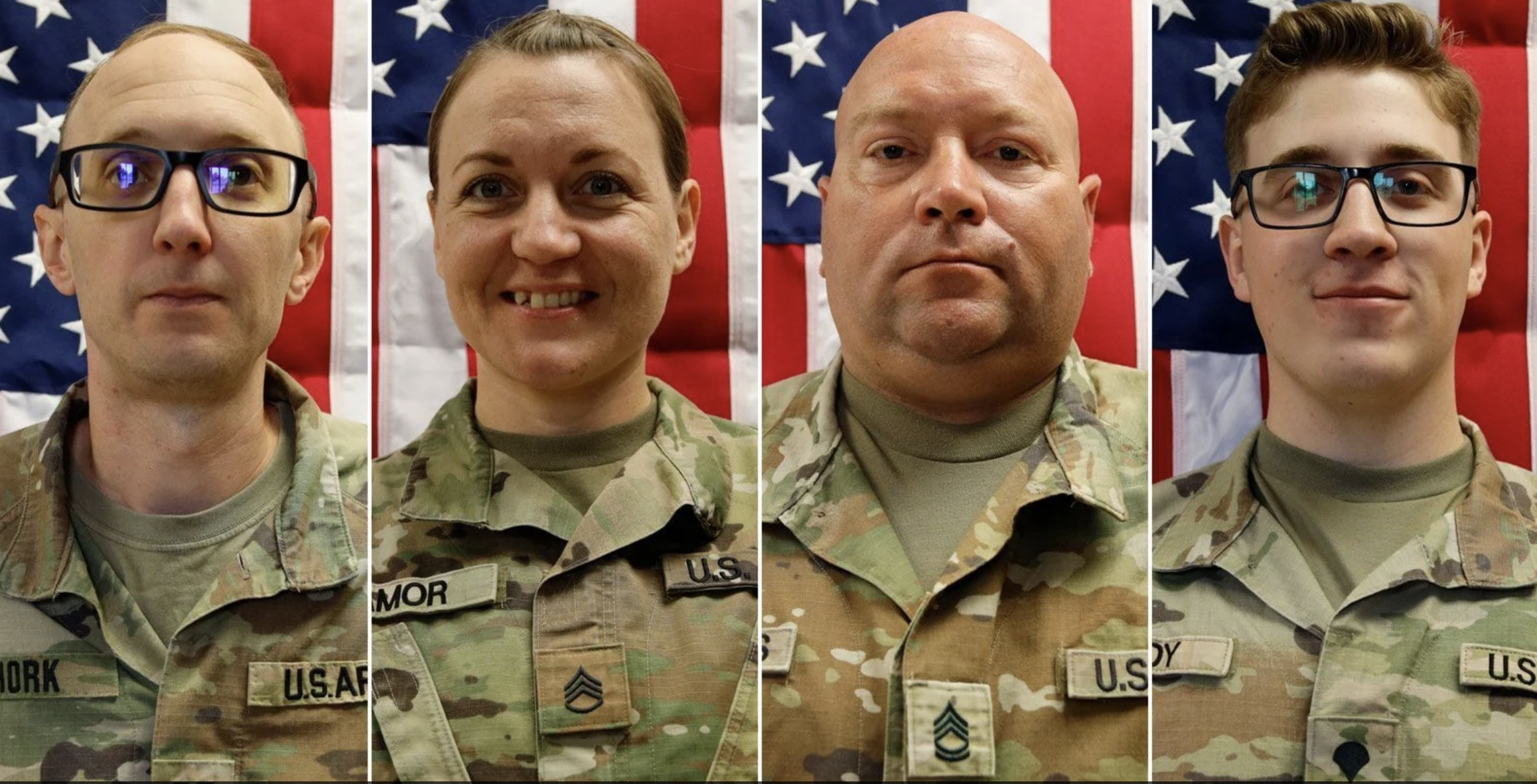
Captain Cody A. Khork, 35, of Winter Haven, Florida. Three deployments. Sergeant First Class Noah L. Tietjens, 42, of Bellevue, Nebraska. Two prior deployments to Kuwait. Sergeant First Class Nicole M. Amor, 39, of White Bear Lake, Minnesota. She was days from going home to her husband and two children. Sergeant Declan J. Coady, 20, of West Des Moines, Iowa. A student at Drake University, promoted posthumously from Specialist to Sergeant. Major Jeffrey O’Brien, 45, of Indianola, Iowa. A cybersecurity manager with nearly 15 years in the Army Reserve. Chief Warrant Officer 3 Robert M. Marzan, 54, of Sacramento, California.
Four of them had served together in Kuwait in 2019. They volunteered to go back.
On March 2, Defense Secretary Pete Hegseth arrived at the Capitol for a briefing in a secure basement room. He told lawmakers the operation was progressing ahead of schedule. The White House released the full objectives of Epic Fury, defining it as a major combat operation focused on destroying Iran’s missile and naval forces. On March 4, a U.S. Navy submarine torpedoed and sank the IRINS Dena off the coast of Sri Lanka. One hundred and one of its 180 sailors remain missing. On March 5, Trump said he wants Iran’s entire leadership structure dismantled and revealed he has names in mind for a “good leader.”
And on February 28—the first day of the war, while classes were in session—a strike hit the Shajareh Tayyebeh girls’ elementary school in Minab, in southern Iran’s Hormozgan Province. One hundred and sixty-five girls and staff were killed. Most of them were between seven and twelve years old. Ninety-five more were wounded. The school was adjacent to an IRGC naval base. CNN, The New York Times, CBC, and Al Jazeera have each conducted independent investigations concluding that U.S. forces were most likely responsible. Reuters reported Friday that U.S. military investigators believe the same. Secretary of State Marco Rubio said the U.S. “would not deliberately target a school.” The U.N. High Commissioner for Human Rights said the office has “significant concerns” about whether the strikes complied with international humanitarian law.
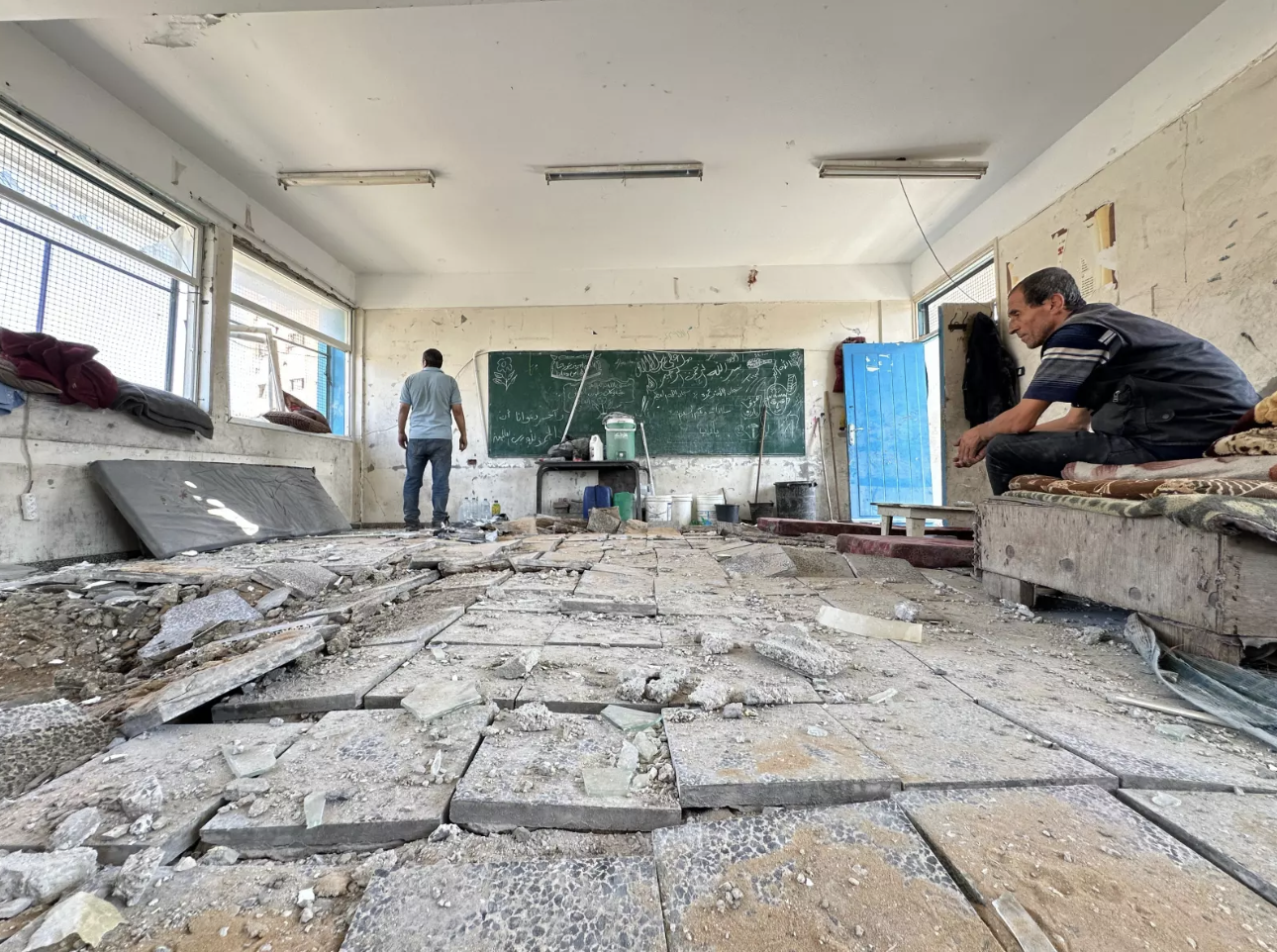
In total, UNICEF reports at least 181 children killed in the first week of the war. At least 20 schools and 10 hospitals have been damaged across Iran.
The Cost Ticker
The Center for Strategic and International Studies published what may be the most important analysis of this war’s first week. Mark Cancian, senior adviser, and Chris Park, research associate, estimated the cost of Epic Fury’s first 100 hours at $3.7 billion—or $891 million per day. Of that $3.7 billion, $3.5 billion was unbudgeted.
Here is what CSIS found that money is buying:
Air operations are running $30 million per day. Naval operations are $15 million per day. Ground support operations are $1.6 million per day. U.S. forces struck approximately 2,000 targets in the first 100 hours, expending an estimated 2,600 guided munitions at a replacement cost of $3.1 billion—none of which was budgeted. Air defense interceptors cost an additional $1.7 billion, as Iran launched over 500 ballistic missiles and 2,000 drones by March 4. Costs to replace combat losses and repair infrastructure damage were estimated at another $350 million.
When you include Iranian retaliatory damage to U.S. assets, the Anadolu Agency estimates the true cost of the first 100 hours at $5.82 billion—0.69 percent of the entire 2026 U.S. defense budget, burned through in four days. That figure includes $2.52 billion in military assets lost to Iranian strikes and a friendly fire incident in which a Kuwaiti F/A-18 pilot shot down three U.S. F-15s. All six aircrew ejected safely.
Compare that burn rate to every American war of the past quarter century:
Figure 1: Daily cost comparison of U.S. military operations in the Middle East. Sources: CSIS (Cancian & Park), CBO, Watson Institute.
This is three times the daily rate of the Iraq War at its peak. And that war lasted eight years.
Kent Smetters, faculty director of the Penn Wharton Budget Model, told CNN that a two-month war could cost between $40 billion and $95 billion, depending on whether the U.S. puts boots on the ground and how quickly munitions are replenished. Lindsay Koshgarian at the National Priorities Project put it in historical context: the Iraq War cost an estimated $3 trillion over two decades. This war is on pace to surpass that rate of spending.
Defense Secretary Hegseth said Wednesday, “We are just getting started,” and added that U.S. forces will be “accelerating.”
The Interceptor Problem
There is a cost buried in the CSIS analysis that should alarm every taxpayer and every defense strategist. Jennifer Kavanagh of Defense Priorities estimates the U.S. “easily” spent more than $10 billion on air-defense systems in the first 48 hours alone. CSIS separately estimates interceptor costs at $1.2 to $3.7 billion for the first 100 hours. The reason is a cost ratio that makes the math of this war unsustainable:
| System | Cost Per Unit |
|---|---|
| THAAD interceptor | $12,700,000 |
| Patriot PAC-3 | $3,700,000 |
| Iranian Shahed-136 drone | $20,000–$50,000 |
| Cost ratio (THAAD vs. drone) | 250:1 to 635:1 |
An Iranian Shahed drone costs between $20,000 and $50,000. A THAAD interceptor to shoot it down costs $12.7 million. The math is not subtle. This is asymmetric warfare working exactly as designed—Iran is bleeding the U.S. financially even when its weapons don’t hit anything.
During June 2025’s 12-day war (Operation Midnight Hammer and related operations), the U.S. expended up to 30 percent of its THAAD stockpile and 80 SM-3 interceptors. Production cannot keep pace: even at quadrupled manufacturing rates, replacing 150 THAAD interceptors takes nearly five months. At sustained conflict consumption rates, the entire U.S. interceptor stockpile could be exhausted in four to five weeks.
This is not just a fiscal problem—it is a strategic one. THAAD and Patriot systems are the backbone of missile defense for NATO, Ukraine, Taiwan, Japan, and South Korea. Every interceptor fired at a cheap Iranian drone is one fewer interceptor available to defend Taipei, Kyiv, or Tokyo. The war in Iran is not just costing money. It is depleting the defense infrastructure that protects American allies worldwide.
The CSIS report noted: “The unbudgeted costs will likely require additional Department of Defence funding, either through a supplemental appropriation or another reconciliation bill.” Translation: Congress will need to appropriate more money. Given that the Senate just rejected a war powers resolution, the question of who authorizes the spending is open.
What Americans Are Paying Right Now
The cost ticker measures what the Pentagon is spending. But the Pentagon’s bill is not the only bill. There is another one, and it arrives at the gas pump.
On the night of Trump’s State of the Union address—February 24, four days before the war began—the national average for a gallon of regular gasoline was $2.92. As of March 6, it is $3.31, according to GasBuddy—a 32-cent spike in seven days, the fastest weekly increase since Russia invaded Ukraine in March 2022. AAA reported the national average at $3.25 as of March 5, up 27 cents in a week. On Tuesday alone, gas prices jumped 11 cents overnight—the biggest single-day spike in three years.
Crude oil tells a starker story. U.S. crude topped $90 per barrel on Friday. Brent crude is above $85. Oil is up roughly 36 percent since the war started and 55 percent from January lows. The reason is the Strait of Hormuz.
The Strait
Twenty percent of the world’s oil passes through the Strait of Hormuz. So does roughly 20 percent of global liquefied natural gas, nearly all of it from Qatar. An IRGC commander declared the strait “closed” and warned that any vessel attempting to pass would be set “ablaze.” At least five tankers have been damaged. Two crew members have been killed. Approximately 150 ships are stranded. QatarEnergy, the state-owned energy company, confirmed it has stopped production at its two main LNG facilities.
European natural gas futures have soared more than 40 percent.
The analyst forecasts are sobering:
Airlines are canceling and rerouting flights across the Gulf. Over 4,000 daily flights have been disrupted. Dubai International Airport and Abu Dhabi sustained damage from Iranian strikes. Every rerouted flight burns more fuel.
Edward Jones chief economist James McCann called the war “another unhelpful inflation impulse.” Supply chains for commodities, plastics, and fertilizers—all of which transit the Gulf—are disrupted. The Federal Reserve, which had been cutting interest rates and signaling more cuts in 2026, now faces a war-driven inflation shock that may freeze monetary policy in place.
The stock market shed roughly $800 billion in market capitalization in a single session on March 6. The Dow dropped 785 points on March 5. On March 3, at its low point, the S&P 500 was down 2.5 percent and the Dow had shed more than 1,200 points intraday. This is what a war without an end date does to markets.

Figure 2: West Texas Intermediate (WTI) Crude Oil Price (Daily). The spike beginning February 28 is the direct consequence of Operation Epic Fury and the effective closure of the Strait of Hormuz. Source: FRED, U.S. Energy Information Administration
How We Got Here
The United States and Iran have been adversaries for seventy-three years. In 1953, the CIA orchestrated the overthrow of Iran’s democratically elected Prime Minister Mohammad Mosaddegh and installed Shah Mohammad Reza Pahlavi, a Western-aligned autocrat who ruled for 26 years with American backing. In 1979, the Islamic Revolution overthrew the Shah and installed the theocracy we are now bombing. The hostage crisis followed—444 days, 52 American diplomats held in Tehran. The relationship never recovered.
Through the 1980s, the United States backed Saddam Hussein in the Iran-Iraq War, a conflict that killed hundreds of thousands. In 2002, George W. Bush named Iran part of the “axis of evil.” Sanctions escalated. Proxy wars escalated. In 2012, Israeli Prime Minister Benjamin Netanyahu stood before the United Nations General Assembly with a cartoon drawing of a bomb and a red line, lobbying the world to strike Iran’s nuclear facilities. He had been making variations of that argument for twenty years. The point is: this is not a new conflict. The hostility between the United States and Iran is older than most Americans alive today. What made the JCPOA remarkable was that it represented the rarest of things—an actual diplomatic breakthrough in a seventy-year standoff.
The Joint Comprehensive Plan of Action—the JCPOA, the Iran nuclear deal—was signed in July 2015 by Iran and the P5+1: the five permanent members of the U.N. Security Council plus Germany. Under its terms, Iran limited its uranium enrichment to 3.67 percent, far below the roughly 90 percent needed for a weapon. It reduced its centrifuges from 19,000 to roughly 6,000. It capped its enriched uranium stockpile at 300 kilograms. It converted the Fordow facility from enrichment to research. It accepted the IAEA’s Additional Protocol—enhanced inspections with access to any suspected site within a managed timeline.
The IAEA issued 15 consecutive quarterly reports from January 2016 through May 2018 confirming that Iran was in full compliance. Trump’s own Secretary of Defense James Mattis and Chairman of the Joint Chiefs Joseph Dunford testified to Congress that Iran was complying. Every U.S. intelligence assessment during this period said the same thing.
On May 8, 2018, Trump withdrew the United States from the deal. He called it “a horrible one-sided deal that should have never, ever been made.” He did not claim Iran was violating the deal’s nuclear terms. He cited Iran’s ballistic missile program, which was not covered by the agreement, and Iran’s regional activities, which were also not covered. His opposition was fundamentally about the fact that it was Obama’s deal—not about the deal’s merits. He couldn’t articulate a specific nuclear violation because there wasn’t one. France, Germany, and the United Kingdom issued a joint statement of “regret and concern.” They tried to preserve the deal without the United States and failed.
What followed was entirely predictable. Iran waited one year, then began exceeding JCPOA limits. By mid-2019, it was enriching above 3.67 percent. By January 2021, it was at 20 percent. After the Soleimani assassination and Israeli sabotage at Natanz, Iran began enriching to 60 percent—a level that represents roughly 90 percent of the technical work toward a weapon. Its stockpile grew to more than 30 times the JCPOA limit. By 2024, the IAEA estimated Iran had enough material for multiple nuclear weapons. In September 2025, the U.N. Security Council reimposed all sanctions.
The trajectory is clear. The JCPOA constrained Iran’s nuclear program. The United States withdrew. Iran accelerated. And now we are bombing the country at almost a billion dollars a day.
Operation Midnight Hammer
This is not even the first time we’ve bombed Iran in the past year. On June 22, 2025, as part of the Twelve-Day War between Israel and Iran, the United States launched Operation Midnight Hammer—a 25-minute strike using seven B-2 Spirit stealth bombers and a submarine, targeting three nuclear facilities: Fordow, Natanz, and Isfahan. Seventy-five precision munitions were used, including 14 GBU-57 Massive Ordnance Penetrators, the largest non-nuclear bombs in the American arsenal. The Brown University Costs of War project estimated the combined cost of Midnight Hammer and related 2025 operations at $4.8 to $7.2 billion.
A July 2025 Pentagon assessment found that Iran’s nuclear program was set back approximately two years. But the same intelligence report noted that Iran had moved most of its enriched uranium stockpile before the strikes. Trump declared the operation had “obliterated” Iran’s nuclear weapons program. In his State of the Union address on February 24, 2026, he said Iran “was warned to make no future attempts to rebuild their weapons program” and accused them of “starting it all over again.”
If Operation Midnight Hammer “obliterated” Iran’s nuclear program, why are we running a billion-dollar-a-day war eight months later?
The Promise and the Reality
What was said before the bombs fell matters.
Trump ran for president in 2024 on “America First.” Fewer foreign entanglements. End the forever wars. His Vice President, J.D. Vance, wrote a Wall Street Journal op-ed in 2023 making the case for Trump’s candidacy with the headline: “Trump’s Best Foreign Policy? Not Starting Any Wars.”
His Director of National Intelligence, Tulsi Gabbard, sold “No War With Iran” t-shirts during her 2020 presidential campaign for $24.99 each. She told the House floor that a war with Iran “would be so costly and devastating it would make our wars in Iraq and Afghanistan look like a picnic.” In 2024, she declared: “A vote for Donald Trump is a vote to end wars, not start them.” Since Operation Epic Fury began, Gabbard has not issued a single public statement. It was later revealed that she had been excluded from the war’s planning meetings entirely. Some within the White House joked that her title—DNI—stood for “Do Not Invite.”
On March 2, the Axios headline read: “Trump campaign peace promises loom large over Iran war.” The article noted what I have been thinking for a week: this may be Trump’s most sincere political conviction—no more Middle East wars—and he is now prosecuting the most aggressive military operation in the region since the 2003 invasion of Iraq.
The operation was launched without a formal address to Congress beyond a War Powers notification and a Gang of Eight briefing. When Senators Tim Kaine, Chuck Schumer, and Adam Schiff forced a vote on a war powers resolution directing the removal of U.S. forces from unauthorized hostilities in Iran, it failed 47 to 53. John Fetterman was the only Democrat to vote no. Rand Paul was the only Republican to vote yes. The House resolution failed 212 to 219. Thomas Massie and Warren Davidson were the only Republicans to vote yes. Four Democrats voted no.
Senator Lindsey Graham warned that adopting the resolution would “handcuff Trump in the middle of a war” and said it would set up a system “where 535 people, after 60 days, become the commander in chief.”
The Ground Troop Question
On Sunday, March 2, Graham went on Meet the Press and said repeatedly that there would be no boots on the ground. Hours later, Trump told the New York Post: “I don’t have the yips with respect to boots on the ground—like every president says, ‘There will be no boots on the ground.’ I don’t say it. I say, ‘probably don’t need them,’ or ‘if they were necessary.’”
Hegseth, asked whether the U.S. currently had troops in Iran, said: “No, but we’re not going to go into the exercise of what we will or will not do. You don’t have to roll 200,000 people in there and stay for 20 years.”
NBC News reported that Trump has privately shown “serious interest” in deploying ground troops, according to two U.S. officials, a former U.S. official, and another person with knowledge of the conversations. He has discussed a post-war Iran in which American forces secure Iran’s uranium stockpile and the U.S. cooperates with a new Iranian regime on oil production.
Trump said the war would likely last “up to five weeks.” Anyone who remembers “Mission Accomplished” knows what that promise is worth.
Meanwhile, a Polymarket user who correctly predicted the strike date and Khamenei’s death—and whom analysts labeled a “suspected military insider”—is now betting six figures that U.S. ground forces will enter Iran before March 31.
The Twenty-Five-Year Bill
Operation Epic Fury did not emerge from a vacuum. It is the latest line item on a tab that has been running since September 11, 2001, and that tab is the single most consequential fiscal fact of the 21st century that almost nobody talks about.
The Watson Institute for International and Public Affairs at Brown University runs the Costs of War Project, the most comprehensive public accounting of post-9/11 military spending. Their headline number: the United States has spent or obligated approximately $8 trillion on the wars in Iraq, Afghanistan, Pakistan, Syria, and related counterterrorism operations since late 2001. That figure includes $5.8 trillion in direct appropriations and a minimum of $2.2 trillion in obligations for veteran care over the coming decades.
| Category | Estimated Cost |
|---|---|
| DOD Overseas Contingency Operations (direct war fighting) | ~$2.3 trillion |
| State Department / USAID (war-related) | ~$296 billion |
| Pentagon base budget increases attributable to post-9/11 wars | ~$884 billion |
| Department of Homeland Security (created post-9/11) | ~$1.1 trillion |
| Veterans Affairs (medical & disability, paid to date) | ~$465 billion |
| VA future obligations (projected through 2050) | ~$2.2–2.5 trillion |
| Interest on war-related borrowing (paid to date) | ~$1.1 trillion |
| Total (through FY2022, including obligations) | ~$8 trillion |
Figure 3: Cumulative cost of U.S. post-9/11 wars. Source: Neta Crawford, Watson Institute Costs of War Project, Brown University (2021 report, updated).
Every dollar of that $8 trillion was borrowed. Every dollar. The post-9/11 wars were the first wars in American history financed entirely through deficit spending. The Revolutionary War had Continental bonds. The Civil War had income taxes and war bonds. World War I had Liberty Bonds and a war surtax. World War II had Victory Bonds, income tax expansion, and top marginal rates that reached 94 percent. Korea and Vietnam had surtaxes. After September 11, the United States did the opposite: it launched two wars and cut taxes twice.
What the Wars Cost in Human Terms
More than 900,000 people have been killed in the post-9/11 wars. Thirty-eight million people have been displaced—more than any conflict since World War II. Approximately 4.1 million American service members deployed to post-9/11 war zones. Of those, roughly 2 million have filed VA disability claims. The PACT Act of 2022 expanded eligibility for burn pit and toxic exposure claims, adding an estimated 3.5 million newly eligible veterans.
Four hundred thousand service members sustained traumatic brain injuries, the “signature wound” of the Iraq and Afghanistan wars, primarily from IED blasts. Moderate-to-severe TBI carries lifetime care costs of $600,000 to $1.8 million per patient. Total TBI burden for the post-9/11 cohort is estimated at $60 to $150 billion over their lifetimes.
Approximately 1,645 service members suffered major limb amputations. A modern prosthetic limb costs $50,000 to $100,000 and must be replaced every three to five years. Lifetime prosthetic costs per amputee run $1.4 to $2.7 million. Advanced bionic prosthetics can cost $500,000 each.
Twenty to thirty percent of post-9/11 veterans have been diagnosed with PTSD. Annual treatment costs run $8,000 to $12,000 per veteran. Lifetime PTSD-related healthcare costs—including associated conditions like substance abuse, cardiovascular disease, and suicide—are estimated at $1 to $1.4 million per veteran. If roughly 500,000 veterans have clinical PTSD, the lifetime cost exceeds $500 billion.
Linda Bilmes at Harvard’s Kennedy School, who has been the leading researcher on long-term veteran care costs, estimates that VA obligations for post-9/11 veterans will reach $2.2 to $2.5 trillion through 2050—most of which has not yet been paid. This is the long tail of war. The bombs stop falling and the spending does not.
That is what almost a billion dollars a day buys. More of all of this.
The Interest Trap
Because every dollar was borrowed, the interest compounds. The Watson Institute estimates that $1.1 trillion in interest on war-related debt had already been paid by FY2022. By 2030, the United States will have spent as much on interest payments as it spent on the wars themselves. Projected interest through 2050 could reach $2 to $6.5 trillion, depending on rates.
With 10-year Treasury yields around 4.5 percent—three times higher than when Neta Crawford published her 2021 estimates—the interest projections may be conservative.

Figure 4: Federal Debt: Total Public Debt (Quarterly). The inflection point after 2001 marks the beginning of deficit-financed war spending. The acceleration after 2008 reflects the financial crisis; the vertical spike in 2020 is COVID. But the baseline was already degraded by two decades of unfunded wars and unfunded tax cuts. Source: FRED, U.S. Department of the Treasury
What We Could Have Had
In January 2001, the Congressional Budget Office projected that the federal government would accumulate $5.6 trillion in surpluses over the following decade. The publicly held national debt was $3.4 trillion. CBO said we could pay it off entirely—every dollar—by 2006.
Read that sentence again. Twenty-five years ago, the United States of America was on track to be debt-free.
Instead of surpluses, the federal government ran deficits from 2002 through 2011. The cumulative swing from projected surplus to actual deficit was $11.7 trillion. CBO’s own retrospective attributed 72 percent of that swing to legislated tax cuts and spending increases—and 27 percent to economic and technical factors.
Three categories of deliberate policy choices consumed that fiscal advantage:
Tax cuts primarily benefiting the wealthy. The Bush tax cuts of 2001 and 2003 (EGTRRA and JGTRRA) reduced revenues by an estimated $1.7 to $2.0 trillion over their first decade. The top 1 percent of earners received roughly a quarter of the total benefits. The Center on Budget and Policy Priorities estimated that when you include extensions and interest, the Bush tax cuts added approximately $5.6 trillion to deficits through 2018. The Trump Tax Cuts and Jobs Act of 2017 cost an additional $1.9 trillion over ten years including interest, according to CBO. The corporate tax rate was cut from 35 to 21 percent—permanently. The individual rate cuts were temporary. Corporate tax revenues fell 31 percent in a single year.
Unfunded wars. The Iraq and Afghanistan Wars consumed roughly $1.8 trillion in direct appropriations—all borrowed, all outside the normal budget process through emergency supplemental appropriations. Total costs including veteran care and interest are projected at $8 trillion and rising.
And now a new war. Another unfunded military operation in the Middle East at approaching a billion dollars a day, with no defined end state and no honest accounting of how it will be paid for.
I need to be honest about the limits of this argument: COVID makes clean counterfactual budgeting impossible. The CARES Act, the American Rescue Plan, and related pandemic relief cost approximately $5 to $6 trillion. That money was bipartisan—the CARES Act passed the Senate 96 to 0—and it was necessary. Every president would have spent heavily in 2020. I am not arguing that we would have a surplus today if not for the wars.
I am arguing something more specific: the United States entered the COVID pandemic with $23 trillion in debt instead of potentially zero debt, and that gap was created by deliberate policy choices—wars we chose to fight and tax cuts we chose to pass, neither of which were paid for. The fiscal cushion that should have existed when the pandemic hit had been consumed by two decades of credit-card governance. Every crisis since has been layered on top of that degraded baseline.
Today the national debt exceeds $36 trillion. The publicly held debt is approaching 100 percent of GDP. And we are adding nearly a billion dollars a day.
The Subsidies We Let Expire
On January 1, 2026, the enhanced ACA premium subsidies expired. Those subsidies helped more than 20 million Americans afford health insurance. The cost to extend them was approximately $38 billion per year. Republicans in Congress and the One Big Beautiful Bill Act failed to extend them. KFF estimates that subsidized enrollees face an average premium increase of 114 percent. CBO projects 2.2 million people will lose coverage.
At nearly a billion dollars a day, roughly 43 days of the war in Iran would pay for a full year of the healthcare subsidies that millions of Americans just lost. One week of the war—roughly $6.2 billion—exceeds the cost of extending ACA subsidies for two months. The OBBBA cut roughly $1 trillion from Medicaid over ten years. The war is running at a pace that would consume that entire “savings” in approximately three years.
Congress couldn’t find $38 billion a year to keep 20 million Americans insured. But when it had the chance to stop a war costing almost $1 billion a day, it voted to let it continue.
What One Day of War Could Buy Instead
This comparison is imperfect. You cannot build 9 schools a day even if you have the money. Infrastructure spending does not scale linearly. But the purpose is not a literal spending plan—it is a sense of magnitude.
| Investment | What One Day of Epic Fury Buys |
|---|---|
| Teacher salaries (starting, $40K/yr) | 22,275 teachers for a year |
| Four-year college scholarships ($50K/yr) | 17,820 full scholarships |
| New elementary schools ($50M each) | ~18 schools |
| Lead pipe replacements ($5,000 each) | 178,200 households with clean water |
| Health centers ($5M each) | ~178 clinics |
| Miles of light rail ($150M/mile avg.) | ~6 miles |
Figure 5: Domestic investment equivalents for one day of Operation Epic Fury spending ($891M). These are illustrative comparisons using standard cost benchmarks, not a literal spending plan.
What America Spends, and What It Doesn’t
The United States defense budget for FY2024 was approximately $886 billion, including the Department of Energy nuclear weapons program and the intelligence community. That is more than the next ten countries combined. The United States accounts for roughly 40 percent of all military spending on the planet.
| Country | Annual Defense Spending | Notable Domestic Investment |
|---|---|---|
| United States | ~$886 billion | — |
| China | ~$296B (official) | 40,000+ km high-speed rail ($800B+ invested) |
| United Kingdom | ~$75 billion | NHS universal healthcare |
| Germany | ~$68 billion | Deutschlandticket (€49/mo nationwide transit) |
| France | ~$62 billion | TGV high-speed rail network |
| Japan | ~$50 billion | Shinkansen, universal healthcare |
Figure 6: Annual military spending vs. notable domestic investments by major countries. Source: SIPRI Military Expenditure Database (2023–2024 estimates).
China has 40,000 kilometers of high-speed rail. The United States has zero. Japan has the Shinkansen. France has the TGV. Germany just launched a nationwide transit pass for 49 euros a month. These countries chose to invest in things their citizens use every day. The United States chose to spend $8 trillion on wars in countries most Americans cannot find on a map.
I am not a pacifist. I believe in a strong national defense. Every president was going to respond to September 11 with force in Afghanistan—that was not a choice, it was a necessity. But Iraq was a choice. Staying in Afghanistan for 20 years was a choice. The two Bush tax cuts and the two Trump tax cuts—those were choices. And this war is a choice. All of those choices have led America to where we are now: a country where one half of the political establishment campaigns on fiscal responsibility while consistently being the half that blows up the budget—and where people in this country suffer, and people around the world suffer, because of it.

Figure 7: Federal National Defense Consumption Expenditures (Annual). The post-9/11 spending surge is visible, as is the brief drawdown during the Obama years before Trump-era increases. Source: FRED, Bureau of Economic Analysis
The Radicalization Problem
One hundred and sixty-five girls died at the Shajareh Tayyebeh school. I keep coming back to this because I think it is the moment that will define how this war is remembered in Tehran, and how it shapes Iranian politics for a generation.
The argument from the administration is that these strikes will destabilize the regime and create space for a better Iran. Trump says he wants to pick Iran’s next leader. I have a question for the people who believe this: when has it worked?
The United States overthrew Saddam Hussein in 2003 and installed a government that collapsed into sectarian civil war, gave rise to ISIS, and ultimately aligned with Iran. The United States helped overthrow Muammar Gaddafi in 2011 and Libya became a failed state with competing governments and open-air slave markets. The United States spent 20 years in Afghanistan, built a government from scratch, and watched the Taliban retake the entire country in 11 days.
The academic literature on “blowback” is extensive and directionally unanimous: bombing civilian populations does not produce grateful allies. It produces radicalized populations. When ISIS swept through Iraq in 2014, its ranks were filled with men who had experienced the American invasion and occupation firsthand—many of them radicalized in U.S.-run detention facilities. The RAND Corporation, the Defense Department’s own research arm, has published extensively on how civilian casualties increase recruitment for extremist organizations.
Iran had a genuine organic opposition movement. The 2022 Mahsa Amini protests—“Woman, Life, Freedom”—were the largest demonstrations since the 1979 revolution, spreading to all 31 provinces. Young, educated, predominantly female protesters risked their lives demanding change from within. That movement was real. It was brave. And American bombs may have destroyed it.
I am not arguing this from some abstract moral framework. I am arguing it from history. I am glad Khamenei is gone. I am terrified of what replaces him, because history says the replacement that emerges from the rubble of American bombs will be worse than the one that emerges from the courage of Iranian citizens.
Trump says he wants to pick Iran’s next leader. The last time the United States picked Iran’s leader was 1953, when the CIA overthrew the democratically elected Prime Minister Mohammad Mosaddegh and installed the Shah. That worked out for 26 years, until the Islamic Revolution of 1979 installed the theocracy we are now bombing. The through-line is seventy-three years long and it bends in one direction.
The Case for War—and Why I Don’t Buy It
The argument for striking Iran is that the regime was developing nuclear weapons, that the JCPOA sunset provisions would have eventually allowed enrichment anyway, that Iran’s proxy network (Hezbollah, Hamas, the Houthis, Iraqi Shia militias) destabilized the entire region, and that a nuclear-armed Iran was an existential threat to Israel and a strategic threat to every Gulf state and to U.S. interests in the region. Trump did not start this confrontation—Iran has been waging a shadow war against the United States and its allies for decades. Sometimes the least bad option is military force.
There is also a historical argument that war is good for the economy. World War II pulled the United States out of the Great Depression, built an industrial base that dominated the world for 40 years, and created the middle class through the GI Bill. Defense spending drives innovation—the internet, GPS, jet engines, nuclear energy all emerged from military research. Lockheed Martin and Raytheon employees have mortgages and children.
I take the first argument seriously. The Iranian regime was dangerous and its nuclear ambitions were real. But the JCPOA was working. Iran was complying. We ripped it up, watched them accelerate, bombed them once, watched them try to rebuild, and now we are bombing them again at three times the daily cost of the Iraq War. At some point the definition of insanity applies.
I take the economic argument less seriously. The conditions that made World War II economically transformative—massive industrial mobilization, full employment, wartime savings that fueled a postwar consumer boom, the GI Bill, and the fact that every competing industrial economy was physically destroyed—do not exist in 2026. Modern wars do not employ millions of workers in factories. They employ a relatively small number of highly trained service members operating expensive technology, funded by debt, with the economic benefits concentrated among defense contractors. The multiplier effect of a Tomahawk missile is not the same as the multiplier effect of a Liberty Ship.
And the 1940s comparison obscures a critical difference: we paid for World War II. Top marginal tax rates hit 94 percent. Americans bought war bonds. The national sacrifice was distributed. This war is being financed by borrowing, which means the cost will be distributed across future generations through interest payments—the most regressive possible form of war financing.
What This Adds Up To
Here is what I know after one week.
The war is costing nearly a billion dollars a day. Six American soldiers are dead. Over 1,300 Iranians are dead, including 181 children. Gas prices are up 32 cents. Oil is heading toward $90. The Strait of Hormuz is closed. The stock market has shed billions. The Senate voted not to assert its constitutional war powers. The President says it will last five weeks but also says he doesn’t “have the yips” about ground troops. His defense secretary says they are “just getting started.” People are placing six-figure bets on prediction markets about whether American soldiers will invade. And 165 girls at an elementary school in Minab are dead.
This war sits on top of 25 years and $8 trillion of war spending that was financed entirely by debt, that consumed a projected $5.6 trillion surplus, and that created long-tail obligations—veteran healthcare, prosthetics, PTSD treatment, interest payments—that will be paid by Americans who are toddlers right now.
The deal existed. It was working. We ripped it up. We bombed them. We bombed them again. And now we are spending almost a billion dollars a day with no defined end state, no congressional authorization, and no honest accounting of how any of it will be paid for.
I was five years old on September 11, 2001. I do not remember a world before the wars. I am starting to think I never will.
Sources & Methodology
This analysis synthesizes reporting and data from defense think tanks, federal agencies, financial institutions, and news organizations covering the first seven days of Operation Epic Fury. Cost data relies primarily on the CSIS analysis by Mark Cancian and Chris Park. Historical war cost data comes from the Watson Institute Costs of War Project at Brown University (Neta Crawford and Stephanie Savell) and the Congressional Research Service (Amy Belasco). Fiscal data draws on CBO historical budget tables and retrospective analyses. Casualty figures are sourced to CENTCOM, UNICEF, and the Iranian Red Crescent, with source attribution noted for each figure. Energy market data comes from the U.S. Energy Information Administration, AAA, and GasBuddy. All figures are subject to revision as the conflict continues.
Cost & Military Analysis
- Center for Strategic and International Studies (CSIS), “$3.7 Billion: Estimated Cost of Epic Fury’s First 100 Hours,” Mark Cancian & Chris Park, March 2026
- Penn Wharton Budget Model, war cost projections ($40–$95B for two-month war), Kent Smetters, via CNN
- Brown University Watson Institute, Costs of War Project, “United States Budgetary Costs of Post-9/11 Wars,” Neta Crawford (2021, updated)
- Brown University Watson Institute, Operation Midnight Hammer cost estimates ($4.8–$7.2B combined 2025 operations), Linda Bilmes
- Congressional Research Service, “The Cost of Iraq, Afghanistan, and Other Global War on Terror Operations Since 9/11,” Amy Belasco (RL33110)
- National Priorities Project / Institute for Policy Studies, Lindsay Koshgarian quotes
- Anadolu Agency, $5.82B total cost estimate including asset losses
- Military Times, interceptor stockpile depletion reporting, March 6, 2026
- Defense Priorities (Jennifer Kavanagh), air-defense cost analysis
Economic Impact & Energy Markets
- AAA, national average gasoline prices (March 5–6, 2026)
- GasBuddy, Patrick De Haan, gas price analysis and single-day spike comparison
- CNBC, WTI and Brent crude oil pricing, Strait of Hormuz reporting
- Bloomberg, Strait of Hormuz shipping halt, QatarEnergy LNG shutdown
- JPMorgan (Natasha Kaneva), $120/barrel scenario; TD Securities, $100/barrel forecast; Deutsche Bank, $200/barrel worst case
- Goldman Sachs, $14/barrel risk premium estimate
- Edward Jones (James McCann), inflation impact analysis
- New York Times, “Gasoline Prices” reporting, March 7, 2026
- CNN, “America is the oil king of the world. So why is the Iran war sending gas prices higher?” March 4, 2026
- NPR, Axios, CBS News, energy market reporting
War Timeline & Casualties
- U.S. Central Command (CENTCOM), Operation Epic Fury press releases and fact sheets
- UNICEF, “The Brutality of War Measured in Children’s Lives,” March 5–6, 2026
- CNN, “Analysis suggests US was responsible for deadly [Minab] strike,” March 6, 2026
- New York Times, CBC, Al Jazeera independent investigations of Minab school strike
- U.N. Office of the High Commissioner for Human Rights (OHCHR), condemnation of school strike
- NPR, NBC News, CBS News, PBS, Pentagon identification of six killed service members
- Al Jazeera, live updates and Iranian retaliation tracking
- Flashpoint, “Escalation in the Middle East: Tracking Operation Epic Fury Across Military and Cyber Domains”
Diplomatic History & JCPOA
- IAEA Board of Governors quarterly reports (GOV/2016/8 through GOV/2018/24), Iran compliance verification
- Arms Control Association, JCPOA factsheets and enrichment timeline
- Council on Foreign Relations, “What Is the Iran Nuclear Deal?”
- Congressional Research Service, “Possible U.S. Return to Iran Nuclear Agreement: Frequently Asked Questions” (R46663)
- CSIS, “What Operation Midnight Hammer Means for the Future of Iran’s Nuclear Ambitions”
- Wikipedia, “2025 United States strikes on Iranian nuclear sites” (cross-referenced)
Fiscal History & Budget Data
- Congressional Budget Office, “The Budget and Economic Outlook: Fiscal Years 2002–2011,” January 2001 ($5.6T surplus projection)
- CBO, “Changes in CBO’s Baseline Projections Since January 2001” (retrospective attribution)
- CBO Historical Budget Data tables (receipts, outlays, deficit/surplus by fiscal year)
- Joint Committee on Taxation, EGTRRA, JGTRRA, and TCJA cost estimates
- Center on Budget and Policy Priorities, analyses of Bush and Trump tax cuts
- Committee for a Responsible Federal Budget, fiscal impact analyses
- U.S. Treasury, Monthly Statement of the Public Debt
Political Context & Prediction Markets
- Axios, “Trump campaign peace promises loom large over Iran war,” March 2, 2026
- Military.com, “Then & Now: Past Iran Remarks from Trump, Vance, Gabbard & Miller Resurface”
- Honolulu Civil Beat, “Iran War Puts Tulsi Gabbard, Regime Change Critic, In An Awkward Spot”
- NBC News, “Trump privately shown serious interest in U.S. ground troops in Iran”
- The Hill, Hegseth and Trump boots-on-the-ground statements
- Newsweek, “$100K Polymarket Winner Wagers on US Forces Entering Iran”
- TechCrunch, $529M traded on Polymarket Iran-related bets
- Snopes, verification of pre-strike Polymarket betting patterns
- ABC News, Washington Post, NPR, Senate and House war powers vote reporting
- Carnegie Endowment, Stimson Center, State of the Union foreign policy analysis
Federal Data Series
- FRED: WTI Crude Oil Price (DCOILWTICO), Federal Debt Total (GFDEBTN), Federal Defense Spending (FDEFX)
- SIPRI Military Expenditure Database (comparative international defense spending)
- VA Healthcare budget data and PACT Act enrollment figures
- Defense and Veterans Brain Injury Center (DVBIC), TBI statistics
- DOD Trauma Registry, combat amputee data